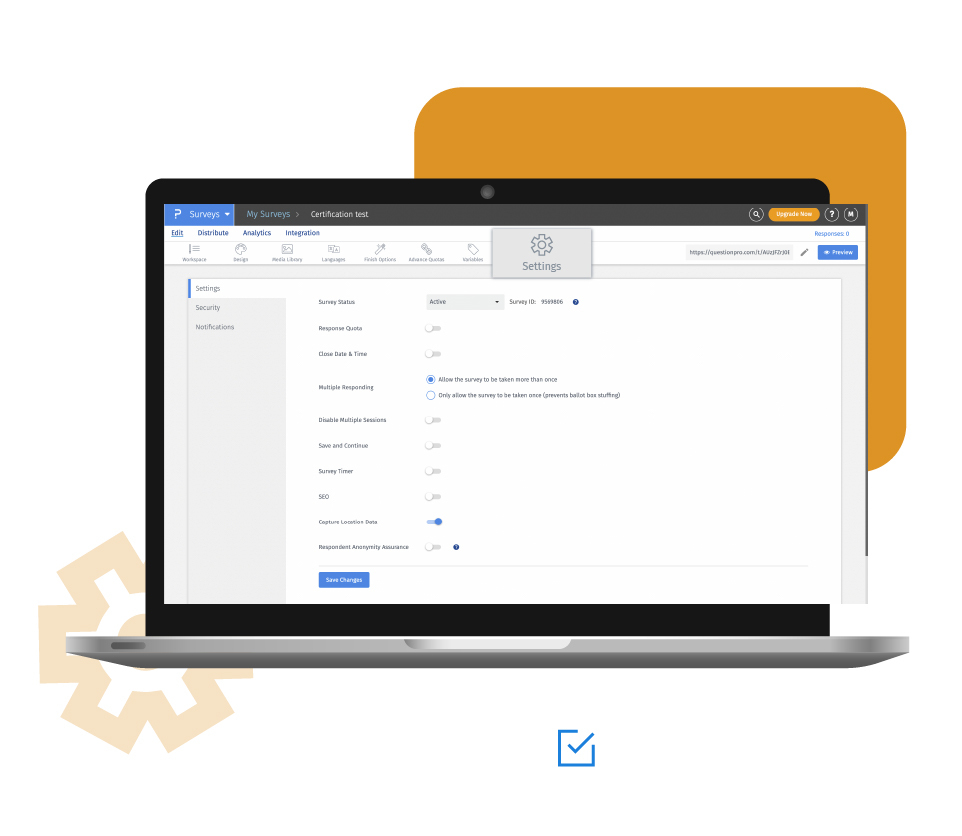
You add it as a question type in Survey Builder, and it verifies respondents before they can move past the page it sits on. Because bots and scripted submissions are stopped before they are ever recorded, your data stays cleaner without you having to comb through responses after the fact. reCAPTCHA V3 in particular does this without asking respondents to do anything at all, which matters most on public links and incentivized surveys across QuestionPro's Research Suite, where bots have the most to gain.
Example of CAPTCHA in your surveys
Consider a national retail chain in the US running a customer satisfaction survey with a gift card raffle for anyone who completes it. Without a CAPTCHA question, the public link and the reward together make an easy target for automated submissions. Adding the CAPTCHA question with reCAPTCHA V3 verifies each respondent in the background, so real shoppers move through the survey without noticing anything new while scripted entries get blocked before they ever reach the dataset.
The Uses of reCAPTCHA
The uses of reCAPTCHA are:
Verification: Confirms a respondent is a real person and not an automated program before their answers are recorded.
Spam prevention: Blocks bots from submitting responses that would otherwise need to be manually identified and removed.
Frictionless screening with reCAPTCHA V3: Verifies respondents in the background, so genuine participants are never interrupted by a manual challenge.
Reward protection: Keeps incentives like gift cards and sweepstakes entries available to the people who actually earned them.
The Advantages of reCAPTCHA in your survey research
The advantages of reCAPTCHA in your survey research are:
Cleaner data from the start: Automated submissions are filtered out before they reach your dataset, so analysis starts with real respondent behavior.
An additional layer of security: Surveys embedded on public websites gain a verification step that only humans can pass.
Protection for incentive programs: Reward-based surveys stay resistant to scripted, repeated submissions designed to exploit them.
Backed by Google's risk engine: reCAPTCHA V3 uses the same behavioral risk analysis technology that protects sign-up and checkout forms across the web, and QuestionPro built it directly into the CAPTCHA question with no separate setup required.
How to Use CAPTCHA in QuestionPro
To use reCAPTCHA in your research studies, read our help file on how to set up CAPTCHA.

 Survey Software
Easy to use and accessible for everyone. Design, send and analyze online surveys.
Survey Software
Easy to use and accessible for everyone. Design, send and analyze online surveys.
 Research Suite
A suite of enterprise-grade research tools for market research professionals.
Research Suite
A suite of enterprise-grade research tools for market research professionals.
 Customer Experience
Experiences change the world. Deliver the best with our CX management software.
Customer Experience
Experiences change the world. Deliver the best with our CX management software.
 Employee Experience
Create the best employee experience and act on real-time data from end to end.
Employee Experience
Create the best employee experience and act on real-time data from end to end.